

Fiber deployment is no longer only a construction challenge. For telecom operators and network contractors, the ability to capture, validate, and synchronize field information can determine how quickly a newly built segment becomes an operational asset. Paper records, delayed updates, and disconnected design tools create gaps between what exists in the field and what appears in enterprise systems. A mobile-first approach addresses this gap by making digital updates part of the field workflow rather than a later administrative task.
Why Fiber Projects Need Faster Field-to-Office Updates
Fiber roll-outs involve planners, designers, contractors, inspectors, and operations teams working across different locations. When field data is recorded separately and entered later, errors can accumulate and project visibility can decline.
Modern fiber network management software therefore depends on a shared data environment. GIS-based telecom platforms show how mobile applications can give field teams access to authoritative network information while allowing updates to flow back to office systems in real time. This reduces dependence on paper and helps office and field personnel work from consistent information.
A Mobile-First Model Makes Design More Actionable
Mobile-first does not simply mean putting a desktop application onto a phone. It means designing workflows around what field personnel actually need to accomplish: checking a planned route, locating an asset, recording construction status, attaching evidence, validating data, and completing acceptance tasks.
It strengthens fiber design by connecting engineering decisions with field conditions. Designers can work from structured network data, while technicians can verify whether planned infrastructure matches actual site conditions. When discrepancies are captured immediately, engineering teams can respond before small changes become costly rework.
Connecting Planning, Construction, and Acceptance
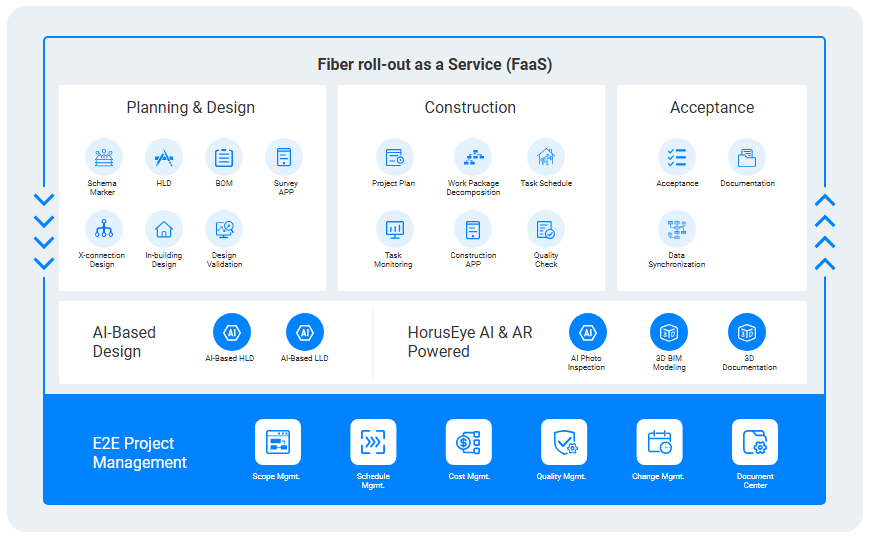
A strong digital framework should follow the entire fiber lifecycle rather than treating design as an isolated phase. Planning establishes the intended network structure; design translates it into buildable routes and assets; construction creates the physical network; and acceptance confirms that the delivered infrastructure meets requirements.
End-to-end fiber network management software can connect these stages through shared workflows and data. Instead of rebuilding information at every handoff, project teams can carry asset records forward and update them as the network changes. This creates a clearer chain from original design to as-built information and eventual operations. GIS-based network platforms similarly support workflows spanning planning, design, construction, and as-built management.
Using AI to Reduce Repetitive Work
AI can add value when it is applied to repetitive, data-heavy activities. During fiber deployment, automation can support tasks such as processing field information, identifying inconsistencies, assisting design workflows, and organizing project data. The goal is to reduce manual effort while keeping engineering judgment central.
For operators managing large roll-outs, this can make software fiber design more scalable. Automated workflows can help teams handle more project information without increasing administrative work at the same rate. This leaves specialists more time for exceptions, engineering decisions, and quality control.
AR and 3D Improve Asset Visibility
Field workers often need to understand infrastructure in relation to the physical environment. Two-dimensional drawings can be effective for engineering, but AR and 3D models can provide additional context when teams inspect or verify assets on site.
Digital twins are also gaining attention in telecom network management because they can create a digital representation of physical network resources and support analysis, diagnosis, simulation, and control. ITU-T work on digital twin networks highlights the importance of data, models, interfaces, and real-time interaction between physical and virtual network environments.
From Field Data to Long-Term Asset Value
The value of field updates extends beyond construction completion. Accurate as-built information can support maintenance, fault handling, capacity planning, service provisioning, and future expansion. Fiber network management software should therefore treat field data as an operational asset, not temporary project documentation.
A unified platform can also improve transparency among contractors, network owners, and operations teams. Shared status information makes it easier to identify delayed work, incomplete records, or assets requiring attention. Over time, consistent data can provide a stronger foundation for decisions about network investment and resource allocation.
Whale Cloud’s Role in Digital Fiber Roll-Out
Whale Cloud’s Fiber roll-out as a Service (FaaS) solution is positioned around a fully digital approach to fiber roll-out management. It covers planning, design, construction, and acceptance through end-to-end lifecycle management, while applying technologies such as AI, AR, and 3D modeling.
For organizations seeking more connected fiber network management, this model brings field activities and digital asset information into one framework. Its emphasis on automation and transparent asset management also supports the broader goal of extracting more value from fiber optic data after deployment.
Building a Faster, More Connected Roll-Out Process
The strongest mobile-first frameworks are not defined by a single application. They connect people, workflows, network models, field observations, and operational systems so that information can move with the project. This is especially important as operators expand fiber networks while facing pressure to control deployment costs and shorten delivery cycles.
For business telecom organizations, the practical advantage is straightforward: faster updates can mean faster decisions, fewer information gaps, and better continuity from design through operations. With digital workflows, AI-assisted processes, and richer asset visualization, fiber design can become part of a continuous deployment environment rather than a standalone engineering activity. For companies evaluating modern approaches to fiber deployment and asset management, contact Whale Cloud to discuss a suitable solution.

