

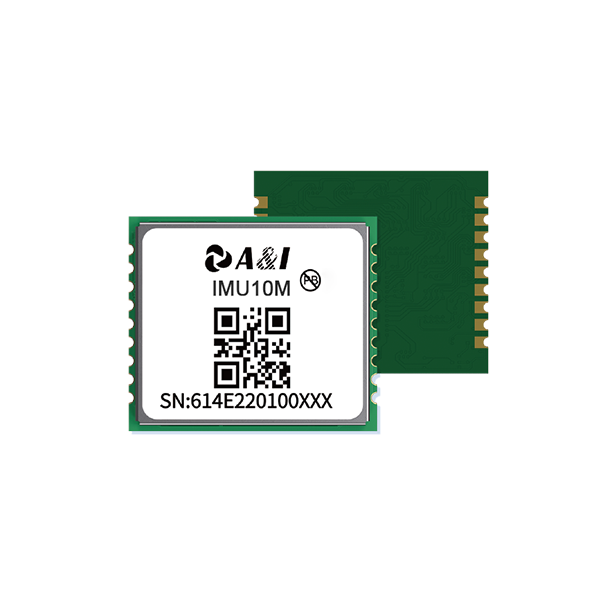
When an industrial machine, drone, or robot has to continually detect acceleration and rotation instead of depending on external position references, a 6 DoF IMU comes in handy. If inertial measurements are necessary for its control software to comprehend motion, that is the question.
A six-axis inertial unit typically combines a three-axis accelerometer with a three-axis gyroscope. The accelerometer measures linear acceleration along three axes, while the gyroscope measures angular velocity around those axes. Together, they provide motion data used for attitude estimation, stabilization, and dynamic tracking.
Robotics: Maintaining State During Motion
Robots often need motion information while executing a task. A mobile robot can use inertial measurements to support orientation estimation while moving through a workspace, while a robotic mechanism can use them to observe vibration, tilt, or changes in rotational motion.
Wherever the sensing element needs to fit into a tiny embedded system, a MEMS inertial sensor is applicable. The miniaturisation of inertial sensing through microfabricated devices made possible by MEMS technology makes the integration of gyroscope and accelerometer capabilities into robotic systems a realistic possibility.
The value is strongest when inertial data complements other sensing. Cameras, encoders, GNSS, lidar, or other sensors can provide information that an IMU cannot provide alone. Robotics systems can fuse these measurements to build a more useful estimate of platform motion and orientation.
Drones: Fast Attitude Feedback
Drones are a direct example of why a 6 DoF IMU is used in dynamic control. Flight involves continuous changes in roll, pitch, and yaw, and the vehicle needs angular-rate information to respond. The Robotics and Perception text from the University of Delaware notes that drones use inertial sensing and explains the role of gyroscopes in measuring orientation changes.
The sensor is not simply recording movement for later analysis. Its measurements can feed the flight-control stack, where current motion information contributes to stabilization and attitude estimation. An accelerometer also senses gravity, which provides a reference useful for estimating tilt, although the drone’s own acceleration must be distinguished from gravity during dynamic operation.
For drone developers, the practical question is how inertial data will be synchronized, filtered, and fused with the rest of the navigation system. A compact embedded unit can be appropriate when the flight computer needs direct access to high-rate motion measurements.
Industrial Motion Tracking: Measuring What the Machine Is Doing
Industrial motion tracking has a different priority. Rather than asking where an autonomous vehicle is on a map, engineers may need to understand how a moving component is rotating, vibrating, tilting, or changing acceleration.
An IMU supplies linear acceleration and angular velocity across three axes. That makes it relevant to robotic mechanisms, stabilization systems, equipment monitoring, and motion-analysis platforms. Six-degree-of-freedom inertial sensing has also been studied specifically for field robotic applications, including sensor-data fusion for motion estimation.
Placement becomes critical in industrial tracking. The unit should be mounted so its sensing axes have a known relationship to the machine coordinate frame. Engineers must also account for vibration, mechanical mounting, sensor bias, sampling behavior, and the requirements of the software consuming the measurements.
Choosing Between an IMU and a Broader Navigation System
A standalone IMU is not the same as a complete navigation solution. It measures inertial quantities; it does not inherently provide an absolute geographic position. Long-term position estimation from inertial measurements alone can accumulate error, which is why navigation architectures commonly combine inertial data with external references.
That distinction matters for system design. If a robotic arm needs motion feedback, an IMU may be one component of the sensing architecture. If an autonomous vehicle needs continuous position and heading, engineers may need a GNSS/INS or another fused navigation solution instead. Archimedes Innovation’s portfolio illustrates this separation by offering inertial and positioning technologies for autonomy-oriented systems.
System selection should follow the measurement requirement: acceleration, angular-rate data, orientation estimation, relative motion, absolute position, or a combination. That answer determines whether a compact inertial device is sufficient or belongs inside a larger sensor-fusion architecture.
What Matters at Integration?
Performance should be evaluated against the motion profile rather than a generic sensor label. A high-dynamics drone, a slowly moving robotic platform, and a vibrating industrial machine can place very different demands on an inertial device.
Engineers should examine measurement range, noise, bias stability, temperature behavior, output rate, interfaces, synchronization, physical size, and mounting constraints. These factors influence whether measurements can be used effectively by control or tracking software.
Archimedes Innovation provides an example of inertial sensing within a broader autonomy stack. Its published navigation products combine IMU measurements with GNSS processing and expose interfaces such as CAN, RS232, RS422, Ethernet, and timing connections on certain systems.
Matching the Sensor to the Motion Problem
The strongest fit is a system where three-axis acceleration and angular-rate measurements add meaningful information to a robot, drone, or industrial motion-tracking platform.
When compactness, integrated integration, and motion response are important, a MEMS inertial sensor is a useful building piece. However, the sensing architecture should also be considered while making this selection.
The right choice depends on whether the application needs inertial measurements alone or a fused solution that also establishes absolute position or another external reference.
Archimedes Innovation positions inertial and positioning technologies within a wider focus on positioning, perception, and control. For B2B engineering teams, that framing leads to a clear selection process: define the motion variables required by the application, map them to sensor inputs, and determine whether a standalone inertial unit or integrated navigation architecture best fits the control and tracking task.

