

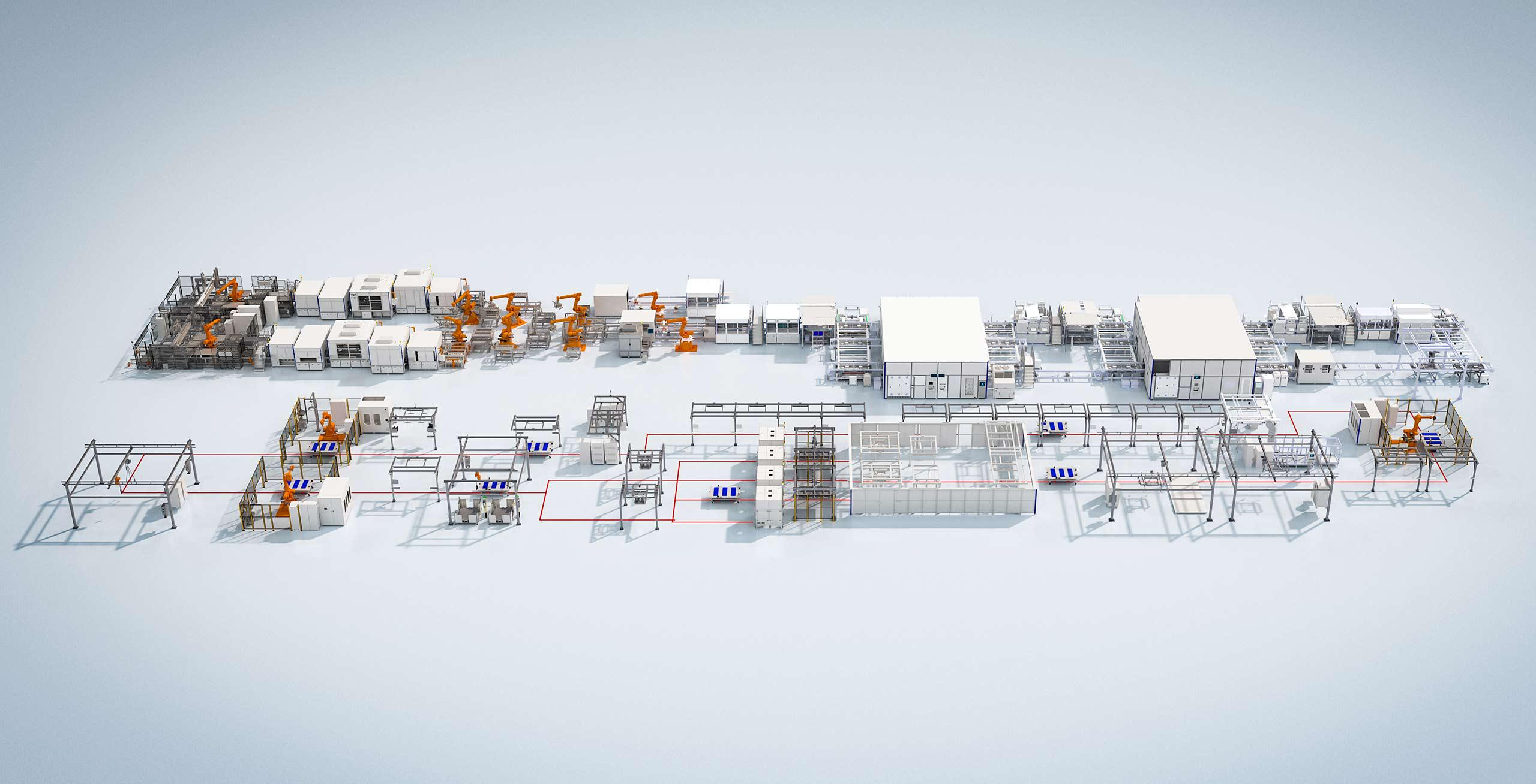
The rapid rollout of electric vehicles raises stringent requirements for battery production stability, as blade cells demand highly controlled assembly workflows. Blade batteries have a long, flat form factor requiring precise handling and coordinated assembly. Minor positioning errors, uneven glue dispensing or welding defects can disrupt downstream processes. Consistent production relies not on standalone machines, but an integrated system covering cell handling to final pack inspection.
Automation helps by making the same operation repeat the same way—reducing manual intervention, standardizing steps, and keeping quality monitoring close to the process. With integrated equipment and intelligent control systems, manufacturers can establish more repeatable production processes and reduce variations between battery packs.
Why Production Consistency Matters in Blade Battery Manufacturing
Blade battery designs place specific demands on manufacturing equipment. Their elongated cell geometry requires accurate positioning, stable transportation, and reliable alignment during stacking and assembly. Lithium iron phosphate (LFP) blade cells feature a long, flat form optimized to boost space utilization within battery packs. These characteristics make precise handling an important consideration during production.
In manual or partially automated environments, differences in operator technique, handling speed, and positioning can introduce process variations. For example, inaccurate cell placement may affect spacing and alignment, while uneven adhesive application can influence bonding quality. If these problems remain undetected, they may create additional rework or quality issues during module and pack assembly.
A standardized production process helps manufacturers control these variables. Automated equipment performs repetitive operations according to predefined parameters, reducing dependence on manual judgment and making production results more predictable.
How Blade Battery Manufacturing Automation Improves Quality Control
- Precise Cell Positioning and Automated Handling
Accurate cell positioning is essential before stacking and module assembly. Automated vision systems can identify cell positions and provide reference data for robotic handling. This reduces inconsistencies caused by manual placement and helps maintain alignment throughout the production process.
For example, the FHS blade battery assembly line uses CCD vision positioning to guide robots in automatically handling battery cells. Combined with AGV transportation and automatic material frame loading and unloading, the system creates a more coordinated material flow while reducing unnecessary manual handling.
- Standardized Testing and Defective Cell Management
Cell quality differences can affect the performance and reliability of finished battery packs. Automated barcode scanning and Open Circuit Voltage (OCV) testing help manufacturers identify individual cells and check their electrical characteristics before assembly.
When a nonconforming cell is detected, automated replacement can prevent it from entering subsequent production stages. This early inspection approach reduces the risk of defects being carried into larger assemblies, where correction may require more time and resources.
- Consistent Adhesive Application and Visual Inspection
Adhesive application and aerogel placement are important processes in blade battery assembly. Variations in application position or coverage can affect downstream assembly quality.
Automated dispensing equipment helps standardize application procedures, while vision inspection checks the quality of gluing and aerogel placement. Defective cells can be automatically separated before qualified components proceed to stacking. This combination of process control and inspection helps manufacturers identify problems closer to their source.
- Controlled Stacking, Welding, and Final Testing
As individual cells move into module and pack assembly, consistent stacking and connection processes become increasingly important. Automated robots perform repetitive stacking operations, while dedicated equipment supports busbar and nickel plate welding.
After welding, automated inspection identifies potential defects before products proceed to subsequent operations. End-of-line (EOL) testing provides another quality checkpoint, helping manufacturers verify finished assemblies against defined acceptance requirements.
What Manufacturers Can Learn from FHS’s Blade Battery Assembly Solution
For battery manufacturers evaluating production upgrades, equipment integration is as important as individual machine capabilities. Jiangsu FHS Smart Technology Co., Ltd. provides intelligent manufacturing automation solutions for new energy, automotive, and other industrial sectors.
Its blade module pack line integrates material transportation, CCD vision positioning, cell testing, adhesive application, aerogel inspection, stacking, module assembly, welding, and final PACK testing into a coordinated workflow.
According to its published product specifications, the line achieves a production capacity of ≥45 PPM, calculated by cell. Its one-time offline qualification rates reach ≥98% for modules and ≥99.5% for PACK, while equipment failure rates are specified at ≤8% for the module segment and ≤5% for the PACK segment.
The equipment also supports one-click changeover between different product models, providing flexibility when manufacturers need to accommodate changing production requirements.
These capabilities demonstrate how integrated automation can support both production efficiency and process consistency. For manufacturers planning new production facilities or upgrading existing lines, FHS offers solutions designed around specific manufacturing processes and project requirements.
Building More Reliable Battery Production Through Automation
Consistency in blade battery production comes from how handling, positioning, testing, bonding, stacking, welding, and inspection are sequenced together—not from any single machine.
By reducing manual variation and introducing standardized process controls, blade battery manufacturing automation helps manufacturers improve repeatability, identify defects earlier, and manage production quality more effectively. With integrated solutions such as those provided by FHS, battery manufacturers can establish more flexible and controlled production lines while preparing for evolving battery designs and increasing manufacturing demands.

