

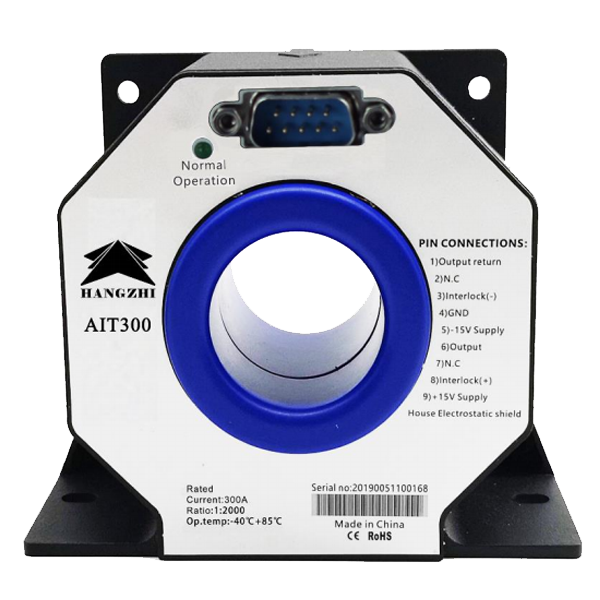
Current data reaches an AI application after a physical measurement chain has turned electrical behavior into a usable record. The record needs more than an amplitude: its timing, operating conditions and relationship to the production task affect its interpretation.
A high performance current transducer belongs at the beginning of that chain, where the electrical quantity is still being established. Smart manufacturing connects this measurement to control and analysis, with a clear account of what the signal represents before a model assigns meaning to it.
Electrical Feedback Inside a Production Cycle
Current feedback supports motor drives, welding systems and robots during their production tasks. The Hangzhi AIT300-SG covers these industrial-control applications, alongside UPS equipment, hoists and elevators.
In a feedback circuit, current is an operating input to control; in a production record, the measured quantity becomes evidence tied to a particular machine and process state. Those uses create different timing and context requirements.
High accuracy sensors contribute a measured value alongside the commanded operating value. A command describes intended operation, whereas a measured trace describes electrical behavior at the sensing point. Comparing them demands a shared time reference and knowledge of the active operation. A difference between readings has to be examined in that context before it can support a judgment about the process.
Within the AIT300-SG, excitation closed-loop control and multi-point zero-flux sensing form part of the measurement architecture. Self-excitation demagnetization, temperature compensation and automatic range switching address the sensing arrangement’s operation. The primary and secondary measurement sides are electrically isolated.
These physical functions establish the signal presented to the next stage, where acquisition equipment must retain the information required for the intended control or recording task.
Preserve the Meaning of Amplitude and Change
The input envelope starts with the actual current waveform. The AIT300-SG has nominal ratings of ±300 A DC and 212 A AC RMS, with a ±360 A measuring range. The AIT400-SG instead specifies ±400 A nominal DC, 282 A AC RMS and a ±480 A measuring range. A high performance current transducer is selected by its defined input requirement, not by its largest current rating alone.
Both models specify a 2 ppm maximum linearity error; their 10 ppm accuracy limit concerns DC input at an ambient temperature of 25 ±20°C. The offset-temperature coefficient is limited to 0.1 ppm/K, and offset change over time to 0.2 ppm/month.
Comparing high accuracy sensors across production runs involves keeping these different dependencies visible, particularly if the ambient temperature or elapsed operating period changes between records.
Rapid events introduce another dimension. Both models specify a −3 dB bandwidth from DC to 500 kHz and a maximum response time of 1 microsecond to 90% of nominal DC current at 100 A/µs.
A record of a changing current needs an acquisition path suited to the event as well as a suitable detector. Static amplitude limits and the ability to follow a transition remain separate parts of the measurement description.
Carry the Signal into an Interpretable Dataset
Secondary current is the electrical handoff from these devices. For the Hangzhi AIT400-SG, a 2000:1 ratio corresponds to ±0.2 A nominal secondary output; the AIT300-SG uses the same ratio with ±0.15 A nominal output.
The receiving electronics must accommodate the selected signal before a digital record can represent the primary current. The transducer ratio describes this conversion, while timestamps and machine identifiers belong to the wider acquisition system.
Within both models’ applicable ranges, their shared ratio gives equal nominal secondary scaling for equal primary currents. The secondary ratings differ because the primary ratings differ. Acquisition settings must retain the chosen scaling when hardware is changed, so that the saved values remain comparable.
Installation conditions accompany the recorded values. The AIT400-SG operates from −40°C to +85°C and at 20–80% relative humidity. Retaining the device configuration and relevant environmental conditions gives later analysis a basis for comparing measurements.
High accuracy sensors supply electrical information, while the surrounding system associates that information with the equipment and operation from which it was obtained.
Data preparation introduces its own choices: an average over a production cycle represents a different quantity from the largest sampled value in that cycle. Units, scaling and any transformation applied during acquisition need to accompany the saved result.
Otherwise, two records carrying the same field name may describe different electrical observations. Retaining that processing history connects a numerical feature used by an AI model to the original current signal from which it was derived.
An AI analysis can then be defined around a specific manufacturing question and an appropriate collection of process records. Equipment identity, time and operating state give a current trace context alongside other available observations.
Any claimed analytical result needs evaluation against that question and dataset. The measurement specification establishes electrical limits; the analysis must establish what an observed pattern means in the production process.
A manufacturing data project can trace its evidence back through the model, acquisition record and physical signal. In that chain, a high performance current transducer from Hangzhi provides a defined measurement role, with current ratings, response criteria and operating conditions attached.
Control and AI analysis can use the resulting information for different tasks. A defensible interpretation begins with a record whose electrical meaning and production context remain recoverable.

