

An ultrasonic cutter is used for detailed trimming in model making, prototyping, craft, and repair work. But the cutter is only one part of a workable bench setup. Storage affects access, organization, and safe handling of a sharp blade. A dedicated base can help, but takes space and must match the cutter.
For wholesalers and tool-kit brands, the question is whether it solves a handling problem at a reasonable cost. Jakemy offers one model-specific option.
What a Holding Base Actually Does
An ultrasonic cutter holding base, sometimes sold as an ultrasonic cutter storage base, gives the tool a designated resting place when not in use. A purpose-built support can reduce clutter and help team members return the tool to the same place.
A base is not a blade guard or a replacement for safe handling procedures. Operators should follow the cutter maker’s instructions, switch the tool off as directed, and avoid touching the blade when positioning or removing it. A holder can improve organization, but it cannot remove risks associated with a sharp cutting edge.
The Main Advantages
Better bench organization. A dedicated space reduces the chance of leaving a cutter among workpieces, cables, scraps, or other hand tools. This can matter in prototyping areas and production workstations where several tasks share a bench.
Convenient access. When operators move repeatedly between cutting and inspecting a workpiece, a holder keeps the tool close at hand without leaving it loose on the table. A consistent storage position can also support repeatable habits across a team.
Greater placement stability. A weighted base and non-slip underside can help the holder stay in place, though it should be used on a level, clean surface.
A practical bundle option. Distributors can offer a holder alongside a compatible cutter as part of a workshop package. For B2B buyers, it can help create product bundles for customers who value an orderly workstation, while customized kits can target different sales channels.
The Drawbacks to Consider
It uses bench space. A separate base may be inconvenient for mobile technicians or cramped workstations. Buyers should check available space and decide whether vertical or horizontal storage better suits their workflow.
Fit is model-specific. A holder designed for one cutter may not support another securely. Confirm the product code and compatibility information rather than assuming similar-looking tools share a holder. This is important for distributors carrying several cutter models.
It adds cost and inventory decisions. Not every end user needs a separate base. Importers can assess whether to sell it as an accessory, include it in selected bundles, or offer both options. Forecasting its demand separately helps reduce the risk of overstocking a slower-moving accessory.
It cannot replace safe work habits. The storage area should be away from bench edges, loose materials, and routine hand movements. A dirty, damaged, or poorly positioned base may not provide the expected stability.
How to Choose a Suitable Design
When comparing an ultrasonic cutter storage base, start with compatibility, then review stability and how the tool sits in the holder. The support should fit the intended cutter without making insertion or removal awkward. Consider whether vertical placement offers better access or horizontal placement works better in a low-clearance area.
It should also be easy to clean, since dust and scraps accumulate on workbenches. For volume buyers, confirm whether accessory-only orders, customized packaging, or other OEM/ODM options are available. These details affect supply planning as well as unit price.
When possible, test a sample at a workstation. Have operators put the cutter in and take it out, then check whether the base shifts or gets in the way of nearby equipment. A trial can reveal issues product photos may not show.
A Model-Specific Option
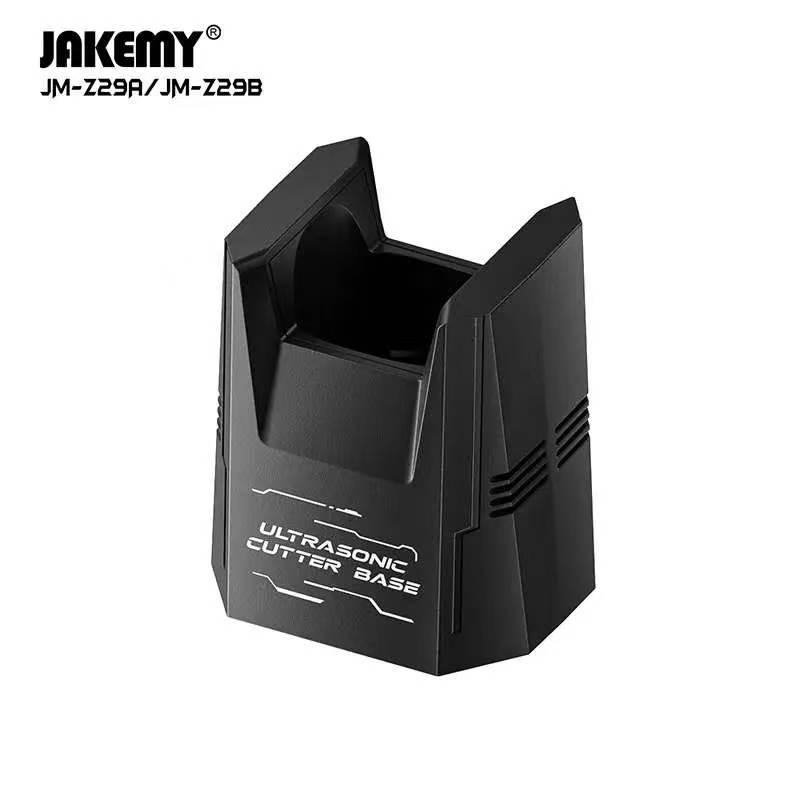
The ultrasonic cutter storage base offered by Jakemy is the JM-Z29A/Z29B dual-mode design. According to the product page, JM-Z29A is made for the JM-Y09, while JM-Z29B is intended for the JM-Y10 and JM-Y10 Pro.
Both versions support vertical insertion and horizontal placement, and use a weighted structure with a non-slip bottom pad. Buyers should confirm the exact cutter model before ordering.
These features address practical concerns around tool placement and base stability. They will not make the design right for every bench, so compatibility and workflow still deserve checking.
The product page lists a minimum order quantity of 100 pieces, sample support, and OEM/ODM customization. This may interest distributors and businesses assembling customized tool kits.
Jakemy describes itself as an independent tool brand with in-house manufacturing, production equipment, and wholesale, OEM, and ODM services. The company also states that it offers warehousing for up to 60 days, with capacity for up to 8 million sets.
Buyers planning a wider accessory range can discuss these capabilities with the supplier, while confirming current lead times and customization scope for each project.
The Verdict for Professional Buyers
A dedicated base is worth considering when a cutter is used frequently, bench organization matters, or a supplier wants to offer a more complete tool package. Its main benefits are convenient access, a defined storage place, and potentially better stability. The trade-offs are space, extra cost, and the need to verify fit.
For buyers assessing Jakemy as a source, the JM-Z29A/Z29B is most relevant when their range includes the compatible JM-Y09, JM-Y10, or JM-Y10 Pro. Checking compatibility, testing a sample in a real workflow, and confirming wholesale or customization terms can help determine whether it belongs in a standard bundle or an optional-accessory list.

