

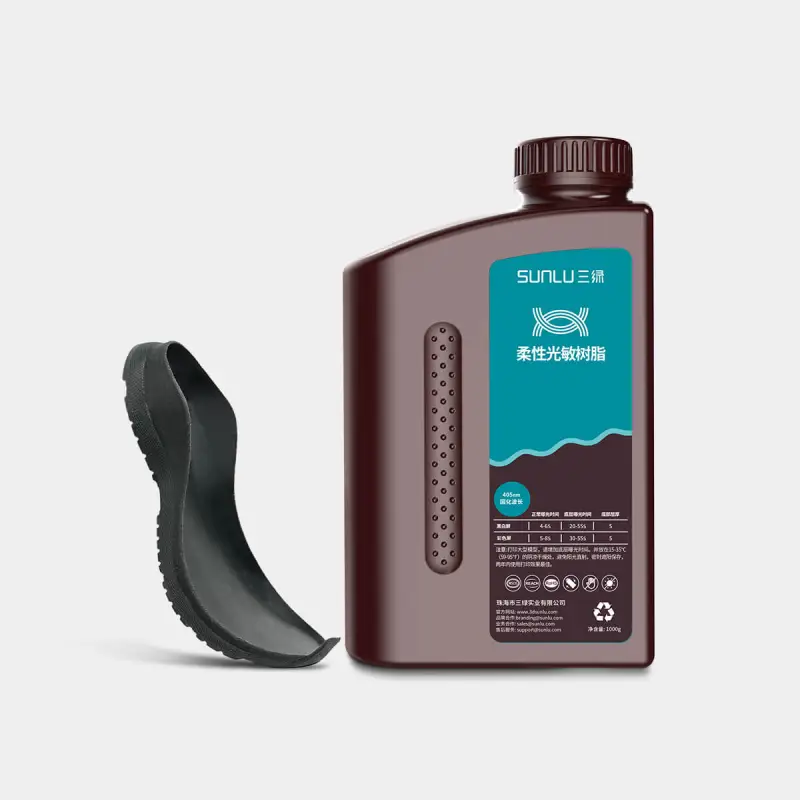
Choosing between flexible resin and tough resin depends on what a printed part needs to do after production. For resin 3D printing, flexible resin is the stronger choice when elasticity, stretchability, and shape recovery are priorities, while toughness resin is better suited to parts that need impact resistance, bend resistance, and durability. SUNLU offers both options, allowing businesses to select a material according to the functional demands of the finished model.
What Makes Flexible Resin Different?
Flexible resin is designed for applications where a printed component needs to deform and recover rather than remain completely rigid. SUNLU Flexible Resin features a Shore hardness of 70A, together with excellent tear resistance and tensile strength. These characteristics allow printed parts to remain flexible while providing durability for functional applications.
For businesses developing functional models, this combination can be particularly useful when the component needs to tolerate repeated deformation. Instead of focusing only on whether a model can withstand force, users can consider whether it can stretch, change shape, and recover effectively during use.
High Elasticity and Rebound for Flexible Applications
One of the key characteristics of SUNLU Flexible Resin is its high elasticity and rebound ability. Printed parts can stretch under external force and quickly return to their original shape. This makes the material suitable for applications where repeated deformation is part of the intended function.
Seals and gaskets are examples of applications that can benefit from this behavior. Such components may need to adapt to shape changes while maintaining their functional form. Flexible resin therefore offers high adaptability when a model is exposed to deformation or external impacts.
What Is Toughness Resin Designed For?
Toughness resin takes a different approach to durability. SUNLU Toughness Resin delivers exceptional toughness and impact resistance, making printed models difficult to break. It also provides excellent rebound performance, combining durability with a degree of elasticity.
This makes toughness resin suitable for models where resistance to sudden external forces is especially important. For business users, the distinction is useful because a component may not need maximum flexibility but may still need to withstand impacts, bending, and repeated handling without breaking easily.
Exceptional Toughness and High Elasticity
SUNLU Toughness Resin provides printed models with outstanding impact resistance and excellent bend resistance. Its resilience helps the models withstand external forces while maintaining stability during long-term use.
This characteristic can be valuable for functional models that are frequently handled or exposed to physical stress. Rather than prioritizing extensive deformation, the material focuses on maintaining durability when force is applied. For applications where breakage is a major concern, toughness resin can therefore offer a practical material option.
Flexible Resin vs Tough Resin: Which Should Businesses Choose?
The most appropriate choice depends on the primary performance requirement. Flexible resin is more suitable when the application requires significant elasticity, stretchability, tear resistance, and rebound. If a part needs to deform and return to its original shape, flexible resin provides characteristics aligned with that requirement.
Toughness resin is more appropriate when impact resistance and bend resistance are the main concerns. Its exceptional toughness makes it difficult to break, while its resilience provides resistance to external forces. This combination supports models intended to remain stable and durable during long-term use.
Compare the Functional Requirements First
Businesses should define the required behavior of the finished part before selecting a resin. Asking whether the model needs to stretch, recover its shape, resist tearing, withstand impacts, or tolerate bending can make the decision more straightforward.
For example, a component designed as a seal or gasket may benefit from the high elasticity and rebound of SUNLU Flexible Resin. A functional model that is more likely to experience impacts or bending may instead benefit from the exceptional toughness and impact resistance of SUNLU Toughness Resin.
This approach also helps prevent material selection based solely on general descriptions such as “strong” or “durable.” Different forms of durability serve different applications, so the material should be evaluated against the actual requirements of the printed component.
Consider the Production Goal
Material selection should also reflect the purpose of the model within the business workflow. When resin 3D printing is used to produce functional models, the printed component may need to replicate specific physical behavior rather than simply achieve a particular appearance.
Flexible Resin and Toughness Resin address different functional priorities. Flexible Resin emphasizes elasticity, rebound, tear resistance, and tensile strength. Toughness Resin emphasizes toughness, impact resistance, bend resistance, and resilience. Understanding these distinctions allows businesses to make a more targeted choice.
Making the Right Resin Selection
There is no universal winner between flexible resin and tough resin. The better material depends on how the printed part will respond to external forces. SUNLU Flexible Resin is designed for flexible applications requiring elasticity and shape recovery, while SUNLU Toughness Resin focuses on toughness, impact resistance, and resistance to breakage.
For businesses using resin 3D printing for functional models, matching these characteristics to the application is the most practical way to choose. When elasticity and deformation recovery are central requirements, flexible resin is the logical option. When impact resistance and durability take priority, toughness resin provides a better fit.

