

Most installation problems are not caused by assembly itself. They appear later, when a flume joint leaks, a pump runs against the wrong pipe size, or nobody can say who approved the landing pool. That is why a Water Slide project is easier to control when it is managed through inspection points and a formal commissioning process instead of one continuous build.
This article follows the sequence from the factory gate to handover: what support a manufacturer can offer before shipment, where checks belong during assembly, and what commissioning should confirm before guests are allowed on the attraction.
Agree on Installation Support Before Shipment
Installation planning works best when it starts while the equipment is still in production. Jinchao states that its typical production lead time is 15–60 days, depending on the size and complexity of the order, which gives the site team a defined window to finish foundations, access routes, and utility connections before components arrive. Delivery can then be sequenced around the order in which sections will be erected, so crews are not searching through crates for the parts they need first.
Support arrangements deserve the same early attention. Jinchao says it provides installation tutorials for its water park products and can dispatch engineers to a construction site to guide local workers. A buyer can use that offer to define who attends, at which stage, and which tasks stay with the local contractor, such as civil works, utilities, and permits.
Documentation belongs in the same conversation. Approved structural drawings, component lists, anchor details, and water-connection points should reach the site team before the first crate is opened. When these records are agreed in advance, every later inspection point has a clear reference to measure against.
Coordinating Structures, Attractions, and Utilities
Once foundations and supporting structures have reached the required stage, water park installation can move into equipment assembly. Jinchao’s published installation guidance describes structural steel towers being erected first, followed by fiberglass flume sections assembled sequentially from upper platforms toward splash pools. Connections are sealed and finished to provide smooth internal riding surfaces, while bolt torque and alignment are checked during assembly.
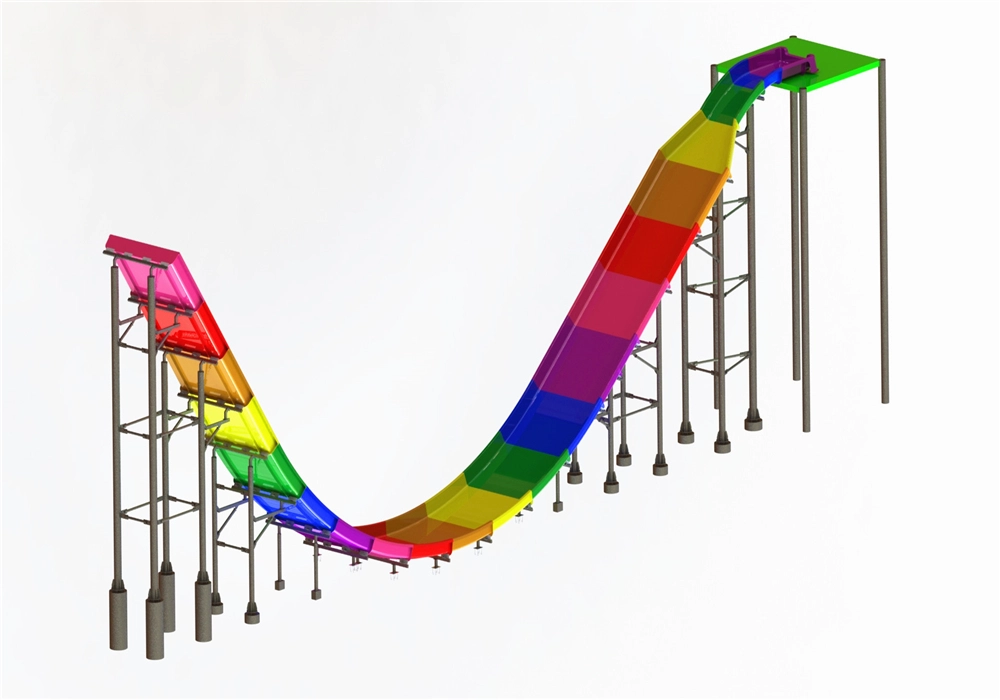
Product configuration also affects the work carried out on site. The Jinchao U-shaped fiberglass water slide has a starting height of 8–12 m, accommodates two persons per lane, and has an approximate hourly capacity of 200–300 persons. Its slide width allows the attraction to be integrated with other slide types on a combined platform, creating a mixture of open and closed waterways. These characteristics illustrate why structural supports, dispatch areas, landing pools, and neighboring attractions need to be coordinated before installation begins.
A water park manufacturer can provide equipment drawings and technical guidance, but the site team still needs to coordinate civil works, mechanical systems, electrical connections, and local construction requirements. Water supply lines should reach their specified connection points, pumps and filtration equipment require suitable space, and maintenance access should remain practical once walls, decking, and landscaping are finished. Good coordination is less about one trade working faster and more about preventing different trades from working against one another.
Using Inspection Points to Control Site Progress
An effective aquatic play equipment installation plan contains inspection points rather than treating installation as one uninterrupted activity. Foundation dimensions can be checked before structures are lifted, connection points can be verified before flume sections are fixed, and hydraulic connections can be inspected before surfaces are closed. This staged approach creates opportunities to identify discrepancies while the affected area remains accessible.
Equipment quality can also be assessed before it reaches the project site. Jinchao states that fiberglass components undergo factory acceptance testing before shipment, with checks covering section alignment, flange thickness, surface smoothness, and structural integrity. Factory preparation can reduce the amount of modification required after delivery and gives site personnel a clearer reference for subsequent assembly.
A detailed water park construction site checklist should extend beyond the attractions themselves. Developers can record concrete and anchor conditions, structural alignment, flange connections, water pressure, electrical connections, drainage, filtration, safety access, signage, and operational controls. Documentation is particularly valuable when several contractors are involved because it provides a shared record of what has been inspected, what remains outstanding, and who is responsible for the next action.
Moving From Assembly to Commissioning
The final stage of water park installation is not simply the moment an attraction becomes physically visible. Mechanical and hydraulic systems need commissioning, water circulation must be tested, and operating teams need practical familiarity with the equipment. Jinchao’s published guidance describes testing electrical connections and water supply lines before mechanical installation, followed by system commissioning and acceptance testing after physical assembly.
Operational readiness also depends on the wider park environment. A water park manufacturer may supply technical documentation or installation assistance, while local teams handle areas such as civil construction, utilities, staffing, and regulatory procedures. Clear responsibility for each task matters during handover because an attraction can be mechanically assembled while surrounding systems are still unavailable for operation.
Final checks should reflect real operating conditions rather than only visual appearance. The water park construction site checklist can include water flow, drainage performance, access to equipment rooms, surface condition, emergency routes, operator positions, and maintenance access. Jinchao states that its services include equipment manufacturing, construction guidance, installation assistance, and ongoing technical support, giving developers a framework for coordinating these stages with the equipment supplier.
Conclusion
The installation phase reveals how closely design decisions are tied to physical execution. Pre-shipment planning, staged inspections, and a documented commissioning process each occupy a different place in the sequence, but none functions on its own. A clear Water Slide layout, a realistic installation schedule, and signed inspection points make site coordination easier to manage and handover easier to verify.
Jinchao combines water park planning, equipment manufacturing, construction support, and installation assistance, supported by a manufacturing base of approximately 36,000 square meters and experience across more than 300 water park projects, according to its official website.

