

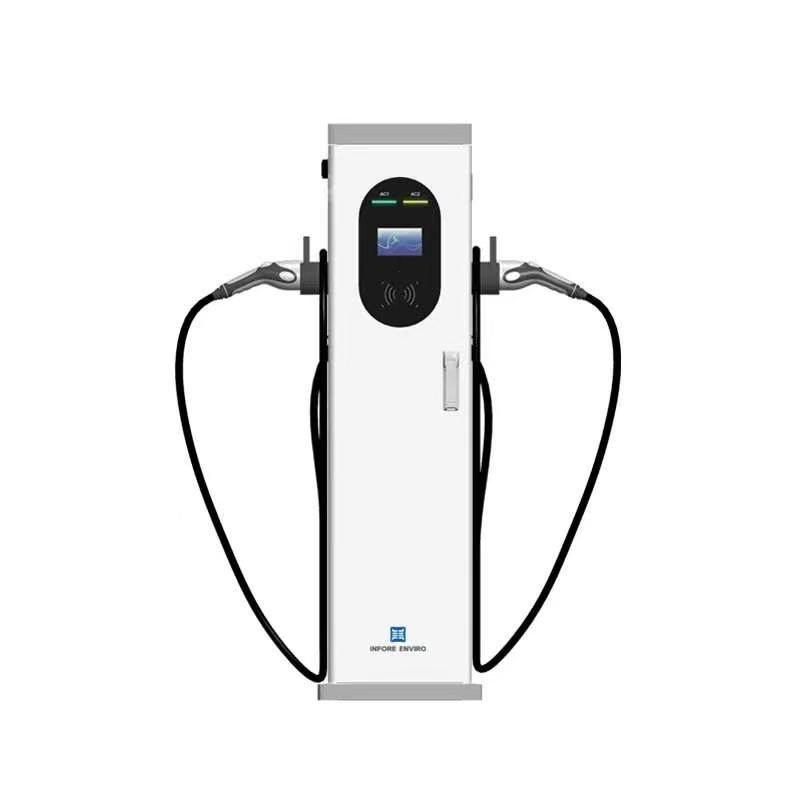
For a business deploying EV charging, the hardware is only one part of the job. Once several charging points are operating, managers have to deal with questions that do not appear on a basic product sheet: Which chargers are available? Are sessions being completed? Can the charging network work with a different backend later? How should charging be scheduled when site demand rises? And who can diagnose a fault without sending a technician to the parking area?
Communication capability matters alongside charging power in commercial deployments. OCPP provides a standardized communication method between charging points and central systems, helping businesses separate charging hardware from management platforms.
A commercial EV charging station can therefore be evaluated as an operating asset, not just a device for delivering power.
- Limited visibility across multiple charging points
A single charger may be manageable locally, but a workplace, fleet depot, hotel, retail site, or parking operator can have multiple points serving different users. Without networked management, operators have less visibility into usage, availability, and charging activity.
A networked commercial charger can connect charging activity with a central platform. OCPP is important because it provides the communication layer between the charger and management system.
The result is a more practical operating model: staff can review charger status, track sessions, and manage charging through software instead of relying on physical checks at every location.
The U.S. Department of Energy notes that networked charging can provide utilization data, monitoring, and customer support, while OCPP-based hardware can ease network-provider changes without replacing charging equipment.
- How an OCPP EV ChargerHelps With Power Coordination
Charging demand does not exist in isolation. At a fleet depot or commercial building, vehicles may be charging while HVAC systems, refrigeration, production equipment, or other loads are active. If many vehicles begin charging at the same time, the site faces a more difficult energy-management task.
An OCPP-connected charger can support smarter charging when the management system is designed to use scheduling and load-control functions. OCPP itself is a communication protocol rather than an energy-saving guarantee, but connected chargers can exchange the information needed for centralized control.
Federal fleet-charging guidance highlights load management and scheduled charging as tools for coordinating EV demand with the rest of a facility.
This becomes more relevant as a business expands from a few workplace chargers to a larger fleet or destination charging area. Operators can set charging priorities around vehicle schedules, occupancy, and available electrical capacity.
- Backend lock-in and future system changes
Technology procurement can become expensive when hardware and software are tightly tied to one supplier. A business may change its charging-network operator, management platform, or service model as its needs develop. Replacing functioning chargers because the backend has changed can create unnecessary disruption.
This is one practical reason businesses evaluate OCPP during procurement. The Open Charge Alliance describes OCPP as an open communication protocol intended to support interoperability between charge points and central systems, regardless of vendor. For B2B buyers, OCPP is part of the infrastructure strategy, not merely a feature listed in a brochure.
- Slow troubleshooting and avoidable site visits
Charging infrastructure generates operational exceptions: a session may stop, a connector may need attention, or communication with the backend may fail. When a company manages sites across different buildings or cities, sending technicians to inspect every incident can consume time and labor.
This is where remote functions become useful. INFORE ENVIRO’s Carina Series 14kW/42kW commercial floor-mounted charger supports OCPP dual-platform connection, remote upgrades and remote diagnosis, alongside 4G, Wi-Fi, Bluetooth, and Ethernet networking. Its specification lists IP54 protection, dual Type 2 guns, a 5-inch touchscreen, and APP/RFID startup.
For a B2B operator, these details matter because maintenance affects uptime and service workload. Diagnostic information can help teams decide whether an issue needs immediate intervention or can be handled remotely.
- Difficulty matching charger design to different operating scenarios
Commercial charging is not one uniform use case. A hotel may have vehicles parked for hours, while a fleet depot may need vehicles ready for dispatch at fixed times. A retail location can have another pattern, with shorter parking sessions and changing occupancy.
That is why product selection should follow the operating scenario. The INFORE ENVIRO commercial range currently includes 7kW/11kW/22kW Vega wallboxes and 14kW/42kW Carina and Navis products.
The company also offers higher-power DC products for fleet depots, logistics hubs, and other high-demand sites. Its 160kW dual-gun CCS2 charger supports OCPP 1.6J, 4G/Ethernet networking, a 2-year warranty, and IP54 protection. This gives B2B buyers room to compare charging power with the operating environment.
A practical procurement point for business buyers
For commercial operators, OCPP is most useful when considered alongside charger power, networking, protection, maintenance access, and charging patterns. The goal is to create infrastructure that remains manageable as usage grows.
INFORE ENVIRO positions itself as a China EV charger manufacturer serving business clients, with OEM and ODM capabilities, dual R&D centers, and products spanning AC and DC charging. Its commercial charging portfolio is aimed at workplace, fleet, public, and other business scenarios.
For B2B buyers comparing suppliers, an OCPP EV charger should be assessed not just by charging speed, but by how well it supports centralized management, future platform choices, maintenance workflows, and changing site requirements. Those operational factors can shape whether a charging network remains practical after the initial installation.

